A child’s outdoor problem-solving often begins with a small obstacle: a ball rolls beneath a bench, a tower of blocks wobbles, or a scooter route ends at a puddle. These moments invite children to predict, test, adjust, and try again. That is the practical heart of how do outdoor toys help develop problem solving skills: they turn abstract thinking into visible, hands-on experiments.
The American Academy of Pediatrics’ 2018 clinical report, “The Power of Play,” links play with executive function, including skills used to pursue goals and manage distractions. Pediatrician and report co-author Dr. Michael Yogman wrote, “Play is not frivolous: it enhances brain structure and function, and promotes executive function.” A systematic review in Children (2020) also examined unstructured nature play and reported benefits across areas of early childhood development. These sources support play as meaningful learning, not merely a way to fill free time.
Consider a child moving stepping stones across grass. Each step tests balance, distance, and the best route. A sandbox encourages another kind of reasoning: which tools will move damp sand, and why does the tunnel keep collapsing? Simple equipment can create rich challenges.
But a toy does not teach by itself. Adults can help by asking, “What could you try next?”—then allowing time for the child to decide. Sometimes the bridge still falls. That is useful, too. Real play is untidy, and children may need room to rethink a plan rather than receive an instant answer.
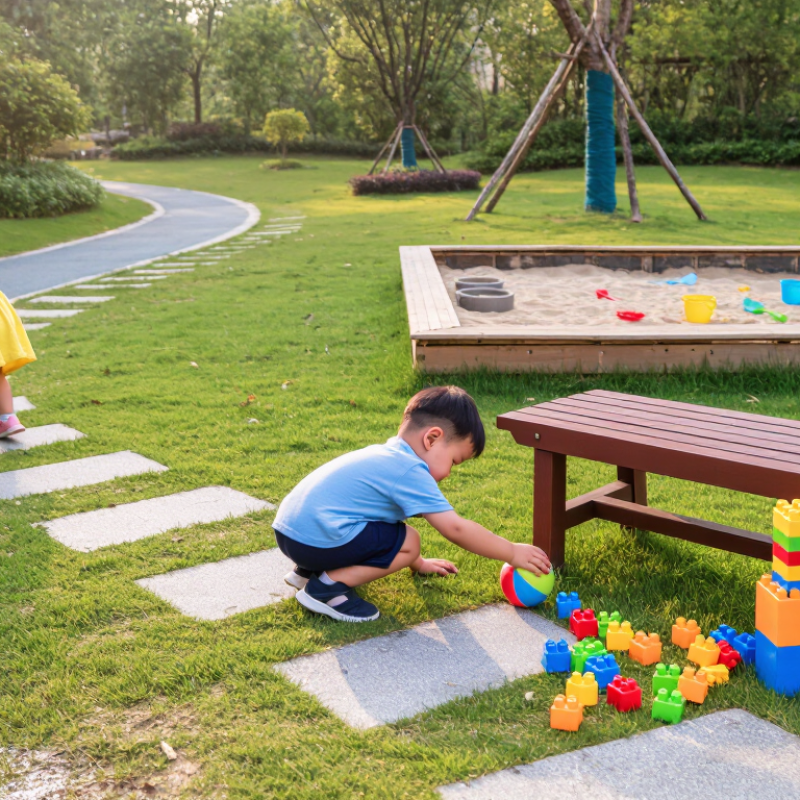
Outdoor toys encourage problem solving when children can test an idea, observe the result, and change their plan.
Interlocking building pieces invite them to design bridges, towers, or ramps on uneven ground. If a ramp is too steep, a toy car may roll off; children can raise one end or add a support. Sand and water play sets offer another kind of challenge. A child can use cups, scoops, and short channels to move water toward a small basin, then spot where it leaks.
Small failures are useful.
Simple obstacle courses made with cones, hoops, and balance boards ask children to choose a route and judge distance. They may reposition a hoop after a jump feels too wide. Ride-on toys with steering and easy-to-move markers also help children plan turns around obstacles, rather than simply move fast.
Cooperative ball games add changing problems: players track direction, decide where to stand, and adapt when a pass misses.
Keep materials age-appropriate and stable, with an adult nearby, especially around water or uneven surfaces. Some toys will frustrate a child before they teach anything. That is worth noticing; offer a small hint, then let them experiment again.
Outdoor play creates small problems children can solve with their hands and eyes: a ball rolls under a bench, a bridge of planks wobbles, or a path turns muddy. Children test ideas, notice what fails, and adjust their plans. The World Health Organization’s 2020 physical activity guidelines recommend at least 60 minutes of moderate-to-vigorous activity daily for children aged 5–17. Active play can help meet that target, but its value is not only exercise. A shifting obstacle course also asks children to judge distance, balance, and effort.
Challenges can feel frustrating. A child may struggle to share a shovel, climb a low structure, or decide whether a puddle is safe to cross. These moments can encourage planning and flexible thinking when adults allow time for attempts while staying close enough to manage hazards. The American Academy of Pediatrics’ clinical report, “The Power of Play,” describes play as supporting problem-solving and self-regulation. Still, not every struggle becomes a lesson; sometimes a child just needs help, or a break.
Tips: Offer loose parts such as sticks, buckets, and cardboard, then ask, “What could make this steadier?” Keep the area age-appropriate and check for sharp edges, unstable equipment, and traffic. Give hints sparingly. A pause can help, though waiting too long may leave a child feeling stuck.
| Outdoor Play Challenge | Example | Problem-Solving Action | Skills Practiced | Helpful Adult Support |
|---|---|---|---|---|
| Building something stable | A block tower or sand structure keeps falling over. | Children test different bases, change the order of materials, and rebuild after noticing what caused the structure to topple. | Planning, cause-and-effect reasoning, persistence, and learning from mistakes. | Ask, “What could make the bottom steadier?” rather than solving the design for them. |
| Choosing a route | A balance path or obstacle course has a gap, uneven ground, or a difficult section. | Children compare possible routes, decide where to place their feet, or adjust the course to make it manageable. | Spatial awareness, decision-making, risk assessment, and flexible thinking. | Help children notice hazards and offer choices while keeping the activity appropriate to their abilities. |
| Moving or transporting materials | A child tries to carry a large collection of balls, leaves, or loose parts across the play area. | They try carrying fewer items, use a container or wagon, or plan more than one trip. | Sequencing, practical reasoning, planning, and adapting a strategy. | Provide a range of safe containers and allow time for children to choose how to move the materials. |
| Working out how to use a tool | A child uses a scoop, bucket, or wheelbarrow to move sand or water. | They experiment with how much to load, how to grip the tool, and how quickly to move it without spilling. | Trial and adjustment, coordination, observation, and understanding how actions affect results. | Demonstrate safe handling when needed, then let the child practice independently. |
| Sharing limited equipment | Several children want to use the same ball, scooter, or digging tool. | Children suggest taking turns, creating a shared game, or finding another material that supports the activity. | Negotiation, communication, cooperation, and considering other people’s ideas. | Help children describe the problem and agree on a fair plan without choosing sides. |
| Changing plans when conditions shift | Wind moves a lightweight construction, or damp sand behaves differently from dry sand. | Children observe the change, select different materials, or modify their original design or game. | Observation, flexible thinking, prediction, and adapting to new information. | Encourage children to describe what changed and discuss possible ways to respond. |
| Keeping a game going | A ball game becomes confusing because players disagree about the rules or boundaries. | Children clarify the rules, mark a playing area, or agree to try a simpler version. | Rule-based reasoning, communication, conflict resolution, and collaborative planning. | Invite each child to explain their idea, then support the group in agreeing on a clear rule. |
How Do Outdoor Toys Help Develop Problem Solving Skills?
How Children Plan, Test, and Adjust Their Solutions
Outdoor play gives children room to make decisions and see what happens next. A child building a path for a toy truck might choose flat stones, then notice one wobbles. They can move it, test the path again, and decide whether the truck rolls more smoothly. These small trials help children connect choices with results. The lesson is practical, not always neat.
A climbing frame, sand tools, or a simple ball game can prompt similar thinking. Children may plan a route, test a throwing distance, or change the rules when play stalls. Sometimes their first idea fails. That can be frustrating, and adults do not need to fix every problem right away. A calm question, such as “What could you try next?”, gives a child space to reflect. Still, some children need help naming what went wrong; trial and error alone is not always enough.
Tips: Offer toys with more than one way to play, and allow time for repeated attempts. Ask open questions rather than giving the answer. Notice the process: “You moved the stone after it tipped.” Keep the challenge manageable, and step in when safety or frustration calls for support.
Children plan an approach, test it through play, and adjust when something does not work.
How to read this chart: The bars show the sequence of a problem-solving cycle, not measured research results. For example, a child building a ramp might plan its shape, test how a ball rolls, then adjust the height or angle.
A child pedaling a tricycle up a small grassy slope may stall halfway and slide backward. That can feel frustrating. Yet the child has useful information: the wheels need more grip, or the slope needs a different approach. After a pause, they may turn the tricycle, push with their feet, or choose flatter ground. Each attempt tests an idea against a real result. Outdoor toys make this feedback visible and immediate, rather than abstract.
Adults can help without taking over. A calm question like “What changed when you turned?” invites a child to notice cause and effect. Specific feedback works better than simply saying “good job”: “You moved the blocks closer, and the bridge held.” Children can then decide what to try next. Not every mistake needs fixing by an adult. Still, frustration varies, and some children need reassurance or a smaller challenge. I have seen well-meant hints arrive too quickly; the child stops experimenting and waits for instructions. It takes restraint to let a safe, manageable problem unfold. An adult should step in when equipment is unstable or a child may get hurt, then explain the concern plainly.
Outdoor play gives children low-pressure chances to solve problems with real materials and changing conditions. A ball rolling under a bench, for example, invites a child to consider its path, reach, and possible tools. If a homemade obstacle course keeps tipping over, children can adjust the spacing or choose steadier objects. They learn to notice what is happening, try an idea, and change it when it fails. Sometimes they get frustrated. That is part of the process, not a sign that the play has gone wrong.
These habits can carry into everyday situations, although the connection is not automatic. A child who plans how to cross a muddy patch may later break a school project into smaller steps. At home, they might look for a missing item by retracing where they last used it. Adults can support this transfer by asking, “What have you tried?” or “What could you change?” rather than immediately fixing the problem. Keep the questions calm and specific. Children may need reminders, and some strategies will not work. Talking briefly about what happened afterward can help them recognize useful approaches for next time.
They let children make choices and observe results. A wobbly stone can change a toy truck’s path. Children can move it and test again.
They plan routes, test ideas, and adjust their approach. A ball game may invite them to change throwing distance or rules. It takes practice.
Not every time. A calm question like “What could you try next?” can encourage reflection. Step in when safety or frustration calls for support.
Acknowledge the difficulty, then ask what the child noticed. For example, “You moved the stone after it tipped.” Some children need help naming the problem.
A child who plans a route around mud may later divide a school project into smaller steps. The connection is possible, not automatic.
They can consider its path, reach, and possible tools. If it rolls under a bench, they may think through how to retrieve it. No single method always works.
They can adjust spacing or choose steadier objects when parts keep tipping over. Repeated attempts help, though frustration may still show up.
Choose materials with several ways to play, such as sand tools, balls, or climbing structures. Leave time for trying again. Adults should watch, too.
Outdoor toys such as building sets, balls, ride-on toys, and sand or water play equipment can turn playtime into a series of small challenges. Children may need to find a way across an uneven surface, build a structure that stays upright, or work out how to share materials and space. These experiences help explain how do outdoor toys help develop problem solving skills: they invite children to observe what is happening, consider possible solutions, and choose an approach.
As children play, they can plan, test an idea, notice what works, and adjust their next attempt. A structure that falls or a game that does not go as planned offers useful feedback rather than a reason to give up. With encouragement, children learn to try again, cooperate with others, and reflect on their choices. Over time, these habits can support problem solving in everyday situations, from completing classroom tasks to handling new challenges with patience and confidence.

ProActive Toys